
|
 |
From left: Project LILI team members Jacob Goldstein, Sophie Jack, Maarij Qureshi, and Joseph Hauerstein.
|
|
Landing on the Moon is no easy task. The terrain is bumpy, and GPS isn’t available to help ensure a precision approach. A number of recent commercial attempts have failed, with the landers tipping over as they impacted the surface.
That’s only one of many logistical issues that must be addressed before humans can establish a long-term lunar presence. As UMD aerospace engineering doctoral candidate Nicolas Bolatto points out, an entire infrastructure is needed, including roads, power stations, and buildings.
A team of University of Maryland (UMD) aerospace students mentored by Bolatto has drawn up some bold ideas. Their project, Lunar Infrastructure and Landing Innovation (LILI), was recently selected as a finalist in the National Aeronautics and Space Administration’s (NASA) Revolutionary Aerospace Systems Concepts—Academic Linkage (RASC-AL) competition, which aims to tap student ingenuity to help overcome major engineering hurdles.
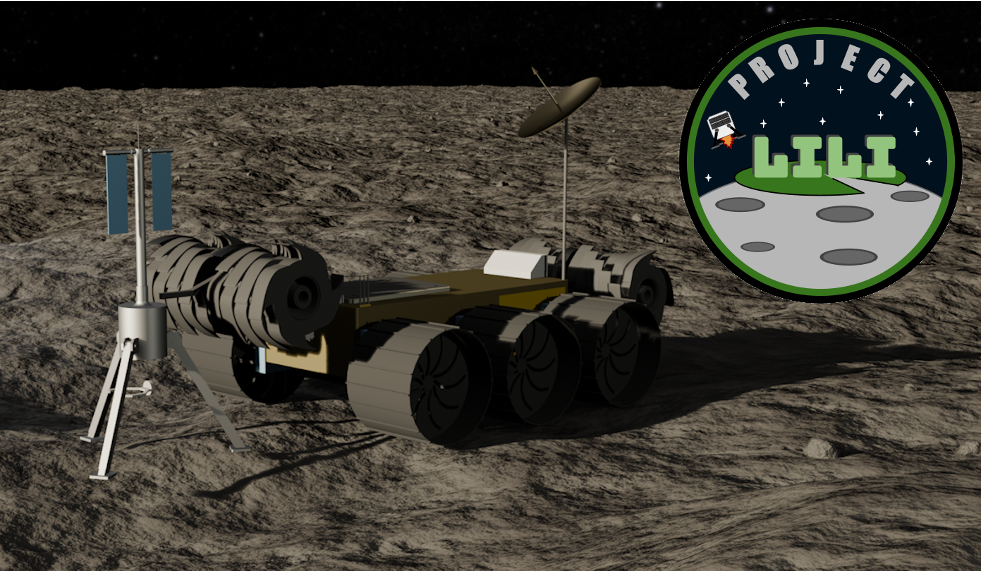 Their ambitious but rigorously worked-out concept calls for sending up a rover, equipped with a power station, that can then start conducting excavations, clearing away dusty regolith, and building landing pads that can be used by future missions. Their ambitious but rigorously worked-out concept calls for sending up a rover, equipped with a power station, that can then start conducting excavations, clearing away dusty regolith, and building landing pads that can be used by future missions.
“The idea is that we get these basics on the Moon that would otherwise be prohibitively expensive, either for commercial companies or for science programs to bring with them,” Bolatto said.
Unlike the ill-fated spacecraft that toppled on rough terrain, these missions would have flat surfaces already prepared for them by the rover. Not only that, but the systems sent up earlier would serve as navigational beacons, allowing for high-precision landings.
“You can bounce information off of the system that’s already on the ground to get your positioning information and land very precisely next to it on the landing pad that you’ve made nice and flat,” Bolatto said. “You’re eliminating a lot of risk and enabling more people–more companies, more countries—to make it to the Moon.”
Following their selection as finalists, the UMD team presented their approach to a panel of final-round judges, seeking to demonstrate in more detail how a robotic rover could be used to carry out the intended tasks. Although the competition prize ultimately went to another team, the judges lauded their thorough analysis and the feasibility of their design.
Team mentor Bolatto is affiliated with the aerospace engineering department’s Space Systems Lab (SSL) and is advised by its director, Professor David Akin. The SSL has been deeply involved in preparations for future Moon exploration, including by designing and testing infrastructure such as habitats and space robotics.
Jacob Goldstein, a student member of the Project Lili team, described the experience as a crowning point of his college career.
“Throughout my time in college, no class, test, or project has taught me as much as I have learned from competing in the NASA RASC-AL competition,” he said. “Learning to work amongst a team of 16 other students, all of whom bring their unique experiences and ideas to the table, has been a uniquely challenging and ultimately rewarding experience. Over the course of the past 6 months, our team worked to find a solution for some of the most pressing challenges that real-world space agencies are facing.”
“Having earned the opportunity to present our work at the RASC-AL finalist competition was rewarding in and of itself; however, the part I found even more so, was being able to share in the ideas of everyone present. Whether in the form of listening to the other presentations, speaking with the judges, or talking with our peers, hearing the ideas and criticism of others was incredibly educational and a fantastic conclusion to my college experience,” Goldstein said.
June 10, 2026
|




