
|
 |
VFS Federal City Chapter President Lauren Wolfe presents certificate for Best Paper Award to Yuval Enciu (photo credit: Mike Hirschberg) |
|
University of Maryland (UMD) Clark Doctoral Fellow and Vertical Flight Society (VFS) Student Council President Yuval Enciu received a Best Paper award at the VFS’s 82nd Annual Forum and Technology Display for work detailing the successful design and testing of a hydrogen fuel cell-powered helicopter—research that could spur the adoption of such fuel sources by the Electric Vertical Takeoff and Landing (eVTOL) industry, contributing to greener and cleaner aviation.
Enciu and co-authors Diallo Ibrahima, Marc-Antoine Pilon, Asher Leach, and Mikael Cardinal took top honors at the eVTOL technical sessions during the Forum conference held in West Palm Beach in May. The research they presented is being led by UMD Professor and Alfred Gessow Rotorcraft Center (AGRC) Associate Director Anubhav Datta.
The research endeavor, known as Project Proticity, was launched by Dr. Martine Rothblatt, the founder and CEO of the biotechnology company United Therapeutics. It is a collaborative effort between the company’s Canadian subsidiary, Unither Bioelectronics, and the AGRC.
As described in the winning paper, “Exploration of a Full-scale Hydrogen Fuel Cell Powered Helicopter through Flight Tests and Analysis,” the goal is to develop a certifiable, zero-emission helicopter, capable of carrying a pilot, lifesaving organs and personnel on missions of 200 nautical miles or more.
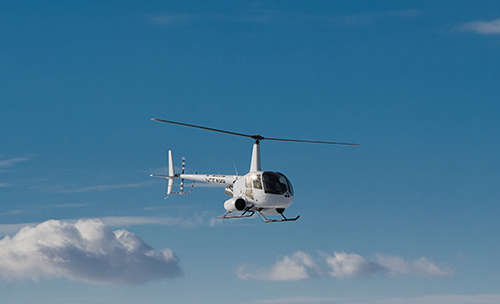
Test pilot Ric Webb flies the first hydrogen-powered Robinson R44 helicopter under Project Proticity, a research collaboration between UMD doctoral student Yuval Enciu and Unither Bioelectronics.
From concept to flight, the project made history on March 27, 2025, at Roland-Désourdy Airport in Bromont, Canada, as test pilot Ric Webb lifted off in the first gaseous hydrogen-powered Robinson R44 demonstrator, for a flight lasting three minutes and 16 seconds. Since then, the aircraft progressed from hover into hover taxi, climb and descent, maneuvering and forward flight at speeds up to 70 kts, allowing the team to successfully carry out rigorous flight tests and modeling.
Enciu documented the architecture and performance of the flying aircraft with rigorous technical detail, including fuel cell electrical characteristics, hydrogen consumption, component weights, radiator drag and aircraft power requirements in hover and forward flight. Project Proticity is the first to publish full-scale test data for a hydrogen-powered helicopter flight, which was not available in the past and prevented the assessment of the true state-of-the-art.
With feasibility demonstrated, the team’s next step is the conversion of the larger turbine-powered Robinson R66 helicopter, using liquid hydrogen storage. Using models anchored to the R44 flight-test data, preliminary results suggest that a liquid-hydrogen aircraft could carry approximately 300-600 lb of payload over a 200-nm mission using current fuel cell technology.
Although the path to a certifiable, zero-emission helicopter is far from complete, the collaborative project between industry and academia is the first step in combatting the irreversible consequences of climate change and global warming. It continues to prove the feasibility of a transportation system capable of moving lifesaving organs sustainably and reliably.
August 7, 2026
|




